The short answer
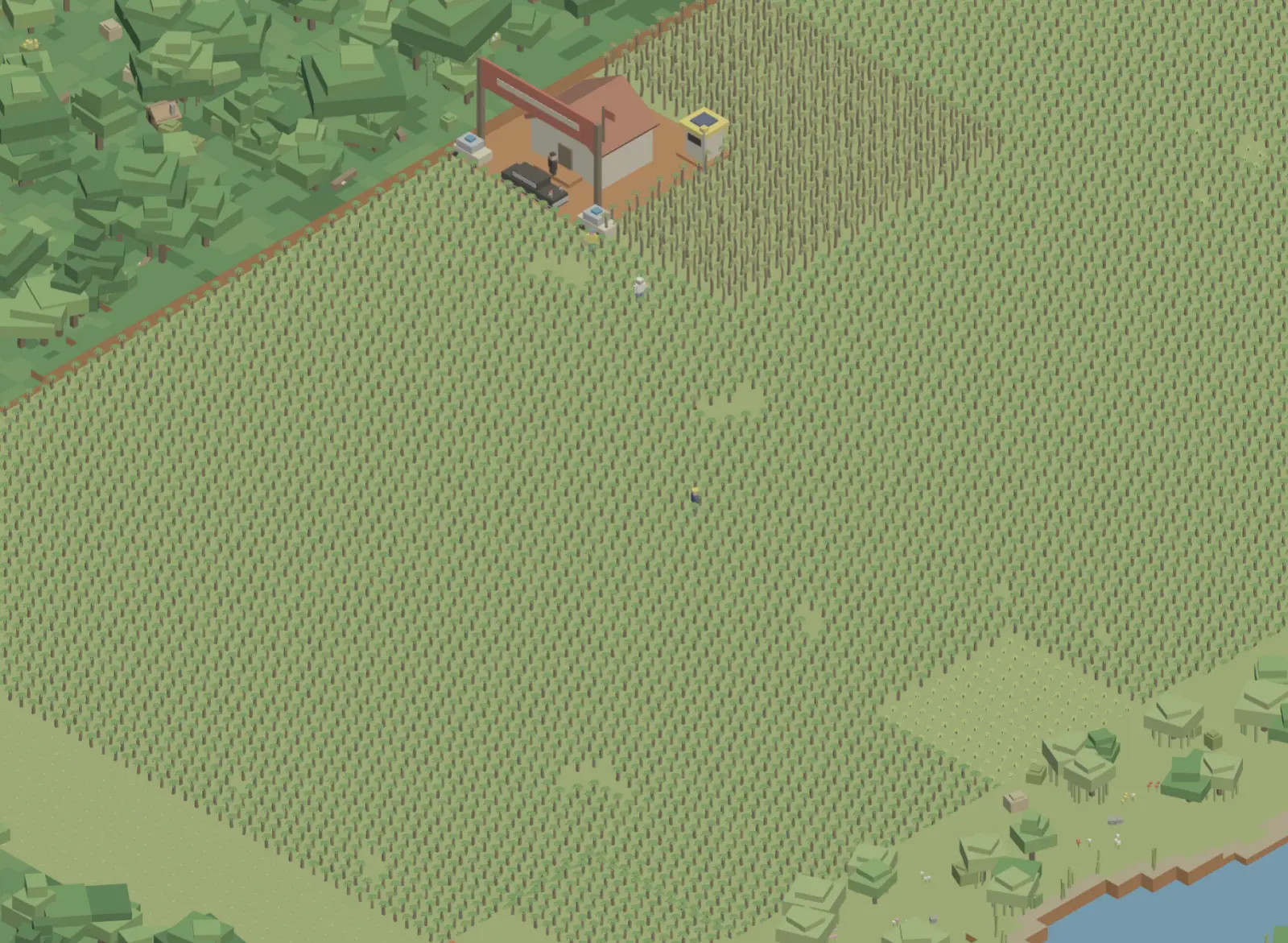
Real systems, invented numbersThe systems are real and the numbers are not. Every mechanism in the game, from the way a burn becomes a wildfire to the way a fungus moves through roots, is modelled on something that happens on real estates in Sumatra and Kalimantan. Every figure attached to those mechanisms, the prices, the days, the probabilities, the thresholds, is tuned so that a run is playable in an evening, and should be read as a caricature with the proportions kept, not as a measurement.
What is modelled on real systems
The shape of each thing, not its size- The fire seasons of Kalimantan and Sumatra. Land is still cleared by fire although it is a crime and land can be cleared without it, dry El Niño years turn those fires into regional disasters, and most of the fire is on land somebody meant to use. CIFOR Forests News on the causes and consequences of the 2015 fires is the clearest short account.
- Haze closing schools. The smoke that follows a fire season closes schools, cancels flights and fills clinics with respiratory cases. Mongabay Indonesia reported schools in West Kalimantan moving online for weeks in the 2026 season.
- Ganoderma spreading by the roots. Basal stem rot, caused by Ganoderma boninense, moves through root contact with infected stumps and neighbouring palms, sits latent for a long time, and is worst on replanted ground. The game's root lattice, its latent stage and its Trichoderma treatment follow the review in Frontiers in Plant Science (2023).
- Beetles breeding in debris. The rhinoceros beetle, Oryctes rhinoceros, breeds in rotting trunks and clearing debris and bores young palms; pheromone traps, sanitation and Metarhizium are the real controls, as the Journal of Oil Palm Research review describes.
- Fruit prices following a dollar world market. Smallholders sell fresh fruit bunches to a mill whose price follows crude palm oil, which is priced in dollars; a weak rupiah, an export levy, a biodiesel mandate or an importer's rule reaches the farm gate within days. The game's headline deck is built on exactly that chain.
- Village cooperatives. Many smallholders sell through a cooperative that also sells inputs and organises labour. The Workshop (Kopdes) is that body.
- Landslides where slopes are stripped. Forest roots hold a hillside, and a cleared slope in a long wet spell does not. The game's slide chance reads the forest cover around each slope for that reason.
- Reforestation taking years. Forest put back is counted from the sapling stage and matures over years, and it is the one thing the authorities take at face value. Auriga Nusantara publishes the deforestation figures the game's forest cover is a toy version of.
- Certification. The Palm Certificate is invented, but its conditions echo what real schemes audit: no burning, forest on the slopes, a working relationship with the cooperative. The RSPO standards are the reference point.
What is invented
Everything with a name, and every number- Every official, office and company. The President, the ministers and the district office in the news deck are fictional characters with invented names, in a kabupaten that does not exist. None of them is a portrait of any real person, and a test in the codebase fails if a real name ever gets in.
- All the numbers. Prices, wages, growth rates, spread chances, the 90-day investigation, the 100-point attention meter, the five-year no-burn rule: tuned for play, not measured. A real estate takes thirty years to do what a run does in an evening.
- The clock. A day is five seconds, a year is 360 days, palms bear at eighteen months rather than the real two and a half to three years, and forest grows back in a year or two instead of decades. The compression is deliberate: a choice has to pay inside the run or the game cannot show its cost.
- The Palm Certificate itself, the integrity stat, the coordination fee and the epilogue's President at the Workshop door are the game's own devices for making a structure visible, not descriptions of any real scheme or ceremony.
What the game is not
Not advice, not a claim about anyoneIt is not agronomic, financial or legal advice; nobody should plant, borrow or burn on the strength of a number in it. It is not a statement about any real person, company, ministry or cooperative, and it names none. It is not a measurement of anything: a player who certifies cleanly has learned the shape of a problem, not its size.
What it is: a management sim that lets you take the shortcut and then shows you the bill, in English and in Indonesian, free, in the browser. If you cite it, cite it as that. If you find a system that is wrong in kind rather than in degree, the guide and glossary say what the game thinks each thing does, which is the place to start the argument.
Sources
Outbound, for the record- CIFOR Forests News: Clearing the smoke, the causes and consequences of Indonesia’s fires
- Mongabay Indonesia: Kebakaran hutan bahayakan kesehatan masyarakat dan rugikan ekonomi (2026)
- Auriga Nusantara: Status Deforestasi Indonesia 2025
- RSPO: our standards, the Principles and Criteria
- Khoo and Chong, Ganoderma boninense: general characteristics of pathogenicity and methods of control, Frontiers in Plant Science (2023)
- Bedford, Advances in the control of rhinoceros beetle, Oryctes rhinoceros, in oil palm, Journal of Oil Palm Research 26(3) (2014)
Ready when you are.
Start a game