The loop
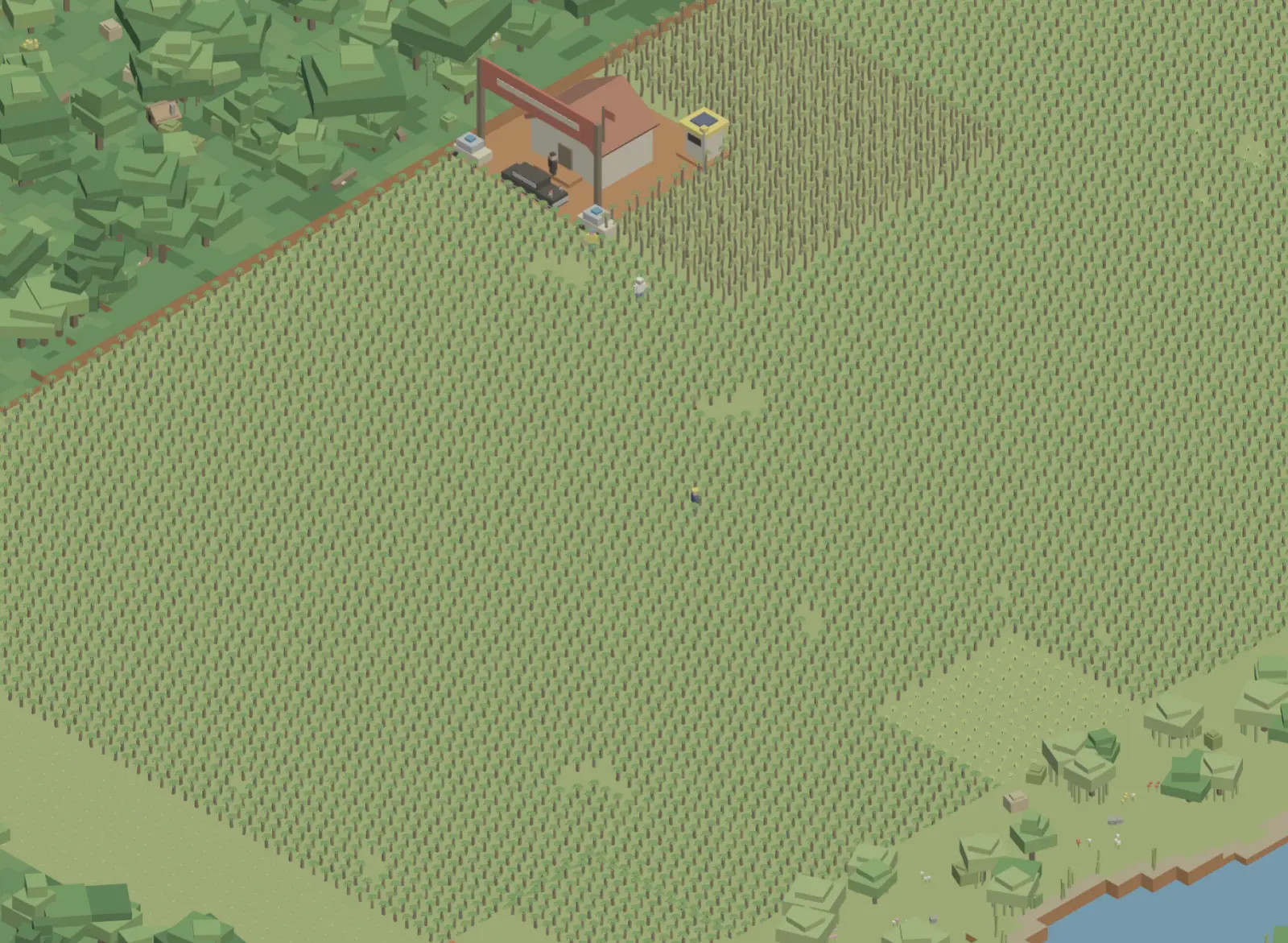
Workshop, land, seedlings, fruitYou start with Rp 250.000.000 and 64 free blocks, one hectare each, with a bare brown block in the middle. Click it and build the Workshop there (the game's village cooperative, Kopdes in Indonesian). Everything the estate buys, sells and staffs runs through it.
Then clear land. Chop puts a crew on a block for a month or so, sells the timber and leaves debris behind. Burn costs Rp 250.000, takes days instead of weeks, and raises the fire pressure meter and the attention of the authorities. Grassfield and scrub have nothing standing on them and need no clearing at all.
Buy seedlings (bibit) at the Workshop shop: 144 fill a flat block, 96 a hillside. Plant, fertilise, irrigate the dry scrub, and wait. Palms bear fruit about eighteen months after planting, so the first year is all cost. Once a block bears, it is ripe for a harvest every six days, inside the Workshop's range only, because fresh fruit bunches (TBS) must reach the mill the same day. The Workshop buys at the day's price. Switch on auto-harvest and its crew does the rounds for a small fee.
Upgrade the Workshop to widen its range: level 2 needs ten bearing blocks, level 3 twenty, level 4 forty, and each step also cuts the price you are paid, because every neighbour is planting palm too. Level 3 opens the payroll (a sanitation worker, a plant doctor, a security guard) and the 50x clock. Level 4 is one of the five certificate conditions.
The fire pressure meter
Past the line the fire is no longer yoursA burn is low, medium or high. Low adds 1 to the estate's fire pressure, medium 3, high 5, and the wildfire line sits at 3: one high burn tips it on its own, one medium burn sits exactly on the line, and low burns spaced months apart never do. Pressure decays slowly, about three points in half a year.
Past the line every fire on the estate escalates, spreads fast into anything dry, and puts a haze over the district that outlasts the flames. Fire spreads three times as readily into standing forest, twice as readily in an El Niño year, and sustained rain can put a block out. Lightning and drought start fires nobody lit; those burn their own block out and never spread, and nobody blames you for them. A man-made fire that reaches a neighbour's land or protected forest is a different matter (see the authorities below).
Pests and treatments
Ganoderma and the rhinoceros beetleGanoderma is slow and structural. It spreads palm to palm through the roots, sits latent for months, turns a palm visibly sick, and eventually kills it. Debris on the block raises the chance of a new infection, and a flood triples it. The answers: Trichoderma from the shop halves the spread on one block for 120 days; remove a sick palm before it infects six neighbours; trench a slot to cut its root links for good; replant the gaps; or hire a plant doctor who pulls two sick palms a day and buys his own Trichoderma.
Rhinoceros beetles are fast and about housekeeping. They breed in whatever a clearing left behind, which is why a burned block is a beetle nursery, and they bore young palms only. Pheromone traps kill beetles on a block for 120 days, Metarhizium slows their breeding for 90, and a sanitation crew removes the debris itself, which is the only fix that starves both pests at once. Left alone, a block tips into plague, and Ganoderma spreads faster there until it clears.
The weather deck
A 360-day year, wet and dryThe wet season runs from day 300 through day 89 of the next year, and each year rolls a regime: normal, El Niño (drier, fire spreads twice as fast) or La Niña (wetter, the river rises). Dry and wet years cluster rather than alternate.
- Haze (kabut asap) comes in the dry season, far more often under El Niño and when the estate's own fire pressure is high. It cuts sunlight and dips the fruit price for weeks.
- Flood comes in the wet season, mostly under La Niña, to the low blocks near the river: young palms take damage, fertilizer washes out, Ganoderma seeds three times as fast. Drainage takes a block off the flood list for good.
- Drought is not drawn, it is twelve dry days in a row. Unirrigated blocks dry out, and under El Niño a debris pile can catch on its own.
- Ash fall is rare: it halts harvests and hurts young palms while it lasts, then leaves 90 days of richer soil behind.
- Landslides take any slope in a long wet spell, and the chance depends on how much forest still stands around it. Strip the hills and the next wet year brings them down; a cover crop halves the risk; an excavation crew digs a buried hectare out inside a week.
The authorities and integrity
A letter at 40, police at 70, arrest at 100Attention is a meter from 0 to 100. Chopping forest raises it a little, burning raises it a lot, and a fire that crosses onto land that is not yours raises it more. Quiet seasons let it fall, and planting forest back is the one thing the Ministry takes at face value: it halves the meter on the spot.
At 40 a letter arrives from the district office and every clearing crew costs half again until the meter falls back under 25. At 70 the police open an investigation: no chopping or burning for 90 days, though harvests and sales go on. A fire that reaches protected forest opens one immediately. At 100, or on a second wildfire while the police are already there, you are arrested, and the run is over.
Integrity is a hidden stat for how honest the district is, and it cuts both ways. A crooked office will let you settle an investigation for a coordination fee of roughly a year's harvests, and will wave the certificate through with a shortfall. An honest one will not take the call, and is the one that can suspend your operating licence on the day of a burn: 90 days with no clearing, no palm planting and no harvest, while planting forest stays allowed.
The certificate's five conditions
Checked at the close of every year, from year 3The Palm Certificate is the win condition, and the panel in the game shows how far each of the five has come. Meet all five and the Ministry sends a banner.
- Operating profit, and three profitable years: a cumulative profit target, with each of the last three closed years in the black.
- Lands bearing fruit: twenty blocks with at least half their palms bearing.
- No burn-to-clear: five years clean, or never having burned at all.
- Forest on the slopes: enough forest left standing around the estate's own hills.
- Workshop at its highest level: level 4, which means forty bearing blocks on the way up.
Profit, hectares and the Workshop are never waived. No-burn and forest can be, but only by a Ministry crooked enough to look away, and the epilogue says so. The honest way is the full five. The endings page has the rest.
Speeds and controls
A day is five seconds at 1xTime runs at 1x, 10x or 50x; the 50x clock opens once the Workshop reaches level 3. Pause whenever you like, and read the news feed: a headline in this game changes a price, a wage or the patience of the authorities, and the chip on the bar shows how long it lasts.
Drag to pan, wheel to zoom, Q/E rotate. Click a block to open its panel, double-click to fly to it. Space pauses; 1 2 3 set the speed. F jumps to the Workshop, K opens its shop, N the news, ? this list in game, Esc closes a panel. Saves live in your browser, with no account; a lost run can be rewound to the start of any earlier year, same seed, same weather ahead, different decisions.
Ready when you are.
Start a game